

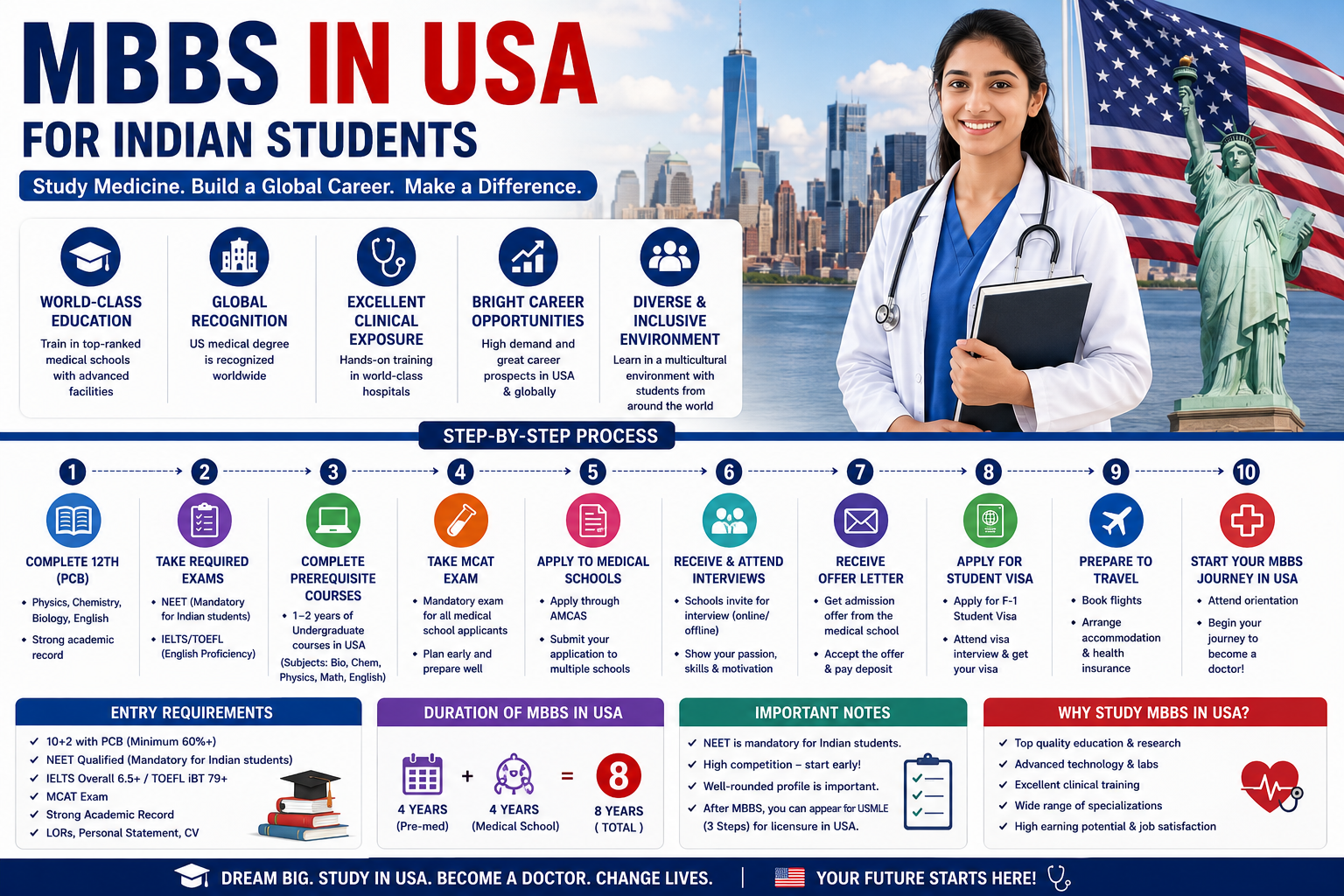
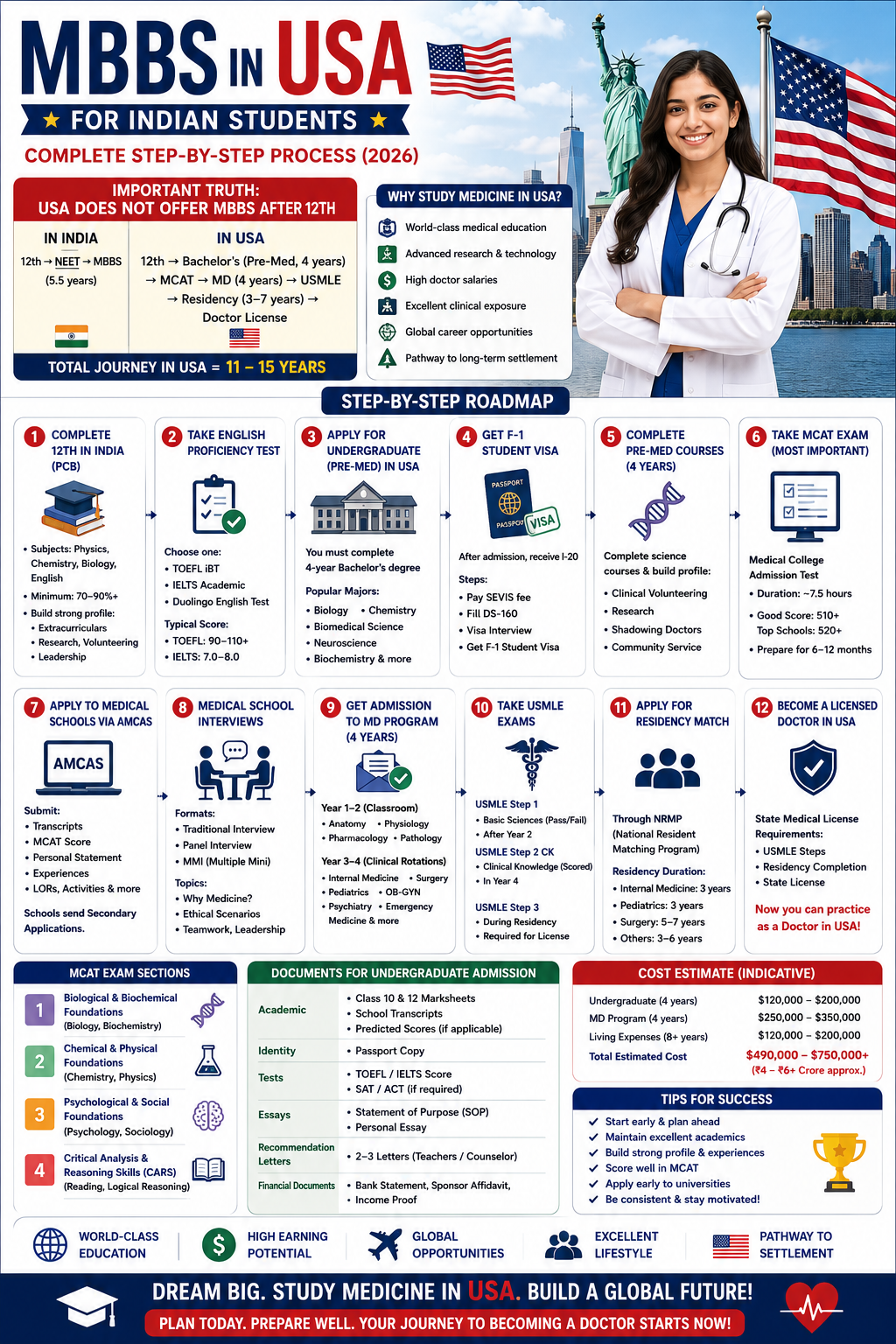
First Important Truth: USA Does NOT offer MBBS after 12th
In India:
12th → NEET → MBBS (5.5 years)
In USA:
12th → Bachelor’s (Pre-Med, 4 years) → MCAT → MD (4 years) → USMLE → Residency (3–7 years) → Doctor License
So total journey is usually:
- 8 years study (4 + 4)
- 3–7 years residency
- Total = 11–15 years
This is the biggest difference.
FULL ROADMAP (Step by Step)
STEP 1: Complete 12th in India (PCB)
Required Subjects:
- Physics
- Chemistry
- Biology
- English
Minimum marks:
- Most universities prefer 70–90%+
- Competitive medical schools prefer excellent academics
Recommended:
- Strong extracurriculars
- Science Olympiads
- Research projects
- Hospital volunteering
- Leadership activities
STEP 2: Take English Proficiency Test
Since Indian students are international applicants, most universities require:
Choose one:
- TOEFL iBT
- IELTS Academic
- Sometimes Duolingo English Test
Typical score expectations:
TOEFL: 90–110+
IELTS: 7.0–8.0
Documents needed:
- Valid passport
- Test registration confirmation
- Score report
STEP 3: Apply for Undergraduate (Pre-Med) Bachelor’s Degree in USA
You CANNOT directly enter medical school after 12th.
You must first complete 4-year undergraduate degree.
Popular majors:
- Biology
- Biomedical Science
- Chemistry
- Biochemistry
- Neuroscience
- Health Sciences
Important:
“Pre-med” is NOT usually a degree itself. It is a course track.
Top universities:
- Harvard University
- Johns Hopkins University
- Stanford University
- University of Michigan
- Boston University
Documents Required for Undergraduate Admission
Prepare these:
Academic Documents
- Class 10 marksheet
- Class 12 marksheet
- School transcripts
- Predicted scores (if applying before result)
Identity Documents
- Passport copy
Tests
- TOEFL / IELTS score
- SAT/ACT (some universities optional)
Essays
- Statement of Purpose (SOP)
- Personal Essay
Recommendation Letters
Usually 2–3 from:
- Biology teacher
- Chemistry teacher
- Principal/Counselor
Financial Documents
- Bank statement
- Sponsor affidavit
- Income proof
STEP 4: Get F-1 Student Visa
After admission:
University sends Form I-20
Then:
- Pay SEVIS fee
- Fill DS-160
- Book visa appointment
- Attend US Embassy interview
Documents required:
- Passport
- I-20
- Admission letter
- SEVIS receipt
- DS-160 confirmation
- Financial proof
- Academic records
- Visa fee receipt
- Passport-size photos
STEP 5: Complete Pre-Med Coursework (4 Years)
During bachelor’s you must complete:
Required subjects:
- Biology
- Organic Chemistry
- Inorganic Chemistry
- Physics
- Biochemistry
- Psychology
- Sociology
- Statistics
- English writing
Also build profile through:
- Clinical volunteering
- Hospital shadowing doctors
- Research publications
- Community service
- Leadership positions
This is extremely important for medical school admission.
STEP 6: Take MCAT Exam (Most Important Exam)
The MCAT is the entrance exam for US medical schools.
Official exam:
Medical College Admission Test (MCAT)
Conducted by:
Association of American Medical Colleges
Duration:
~7.5 hours
Sections:
1. Biological & Biochemical Foundations
Tests:
- Biology
- Biochemistry
2. Chemical & Physical Foundations
Tests:
- Chemistry
- Physics
3. Psychological & Social Foundations
Tests:
- Psychology
- Sociology
4. Critical Analysis & Reasoning Skills (CARS)
Tests:
- Reading comprehension
- Logical reasoning
Scoring:
472–528
Competitive score:
- Good: 510+
- Top schools: 520+
Preparation time:
6–12 months
MCAT fee:
~$335+
STEP 7: Apply to Medical Schools via AMCAS
Application portal:
American Medical College Application Service
Application includes:
- Undergraduate transcripts
- MCAT score
- Personal statement
- Work experience
- Clinical experience
- Volunteer hours
- Research work
- Letters of recommendation
- Activities section
Medical schools then send:
Secondary Applications
These ask:
- Why this school?
- Ethical situations
- Career goals
- Diversity contribution
Extra fees apply.
STEP 8: Medical School Interviews
If shortlisted:
Interview formats:
- Traditional interview
- Panel interview
- Multiple Mini Interviews (MMI)
Questions asked:
- Why medicine?
- Ethical dilemmas
- Teamwork situations
- Leadership examples
- Why our school?
STEP 9: Get Admission to MD Program (4 Years)
This is USA’s equivalent of MBBS.
Years:
Year 1–2
Classroom/basic sciences:
- Anatomy
- Physiology
- Pharmacology
- Pathology
Year 3–4
Clinical rotations:
- Internal Medicine
- Surgery
- Pediatrics
- Psychiatry
- OB-GYN
- Emergency Medicine
STEP 10: Take USMLE Exams
Very important licensing exams:
USMLE Step 1
Tests:
Basic sciences
Pass/Fail
Taken after Year 2
USMLE Step 2 CK
Tests:
Clinical knowledge
Scored
Taken in Year 4
USMLE Step 3
Taken during residency
Required for independent practice
Official exam:
United States Medical Licensing Examination
STEP 11: Apply for Residency Match
Platform:
National Resident Matching Program
Residency duration:
- Internal Medicine: 3 years
- Pediatrics: 3 years
- Surgery: 5 years
- Neurosurgery: 7 years
You are paid during residency.
Typical salary:
$60,000–$85,000/year
STEP 12: Become Licensed Doctor in USA
After:
- MD completed
- USMLE passed
- Residency completed
Apply for state medical license.
Now you can work as full doctor in USA.
TOTAL COST (Approx for Indian Students)
Bachelor’s (4 years)
$120,000–$250,000
MD Program (4 years)
$180,000–$350,000
Living costs
$15,000–$25,000/year
Total estimated:
₹3 crore – ₹6 crore
This is why scholarships are very important.
Scholarships Available
Some options:
- Merit scholarships
- Need-based aid
- University grants
- Research assistantships
- International student scholarships
Some schools give very limited aid to international MD students, so funding is competitive.
Important for Indian Students Returning to India
If planning to practice in India later:
Check compliance with:
National Medical Commission
Verify:
- University recognition
- Degree recognition rules
Also note:
NEET qualification may still matter under Indian foreign medical graduate rules.
Best Students for This Path
USA medical pathway is ideal if student has:
✅ Strong academics (90%+)
✅ Financial capacity / scholarship potential
✅ Excellent English
✅ Research interest
✅ Long-term patience (11–15 years)
✅ Wants global medical career
If Student Wants Faster / Cheaper Option
Better countries:
- United Kingdom
- Australia
- Georgia
- Russia
- Kazakhstan
Because they allow direct medical entry after 12th.
Final Timeline Example
Age 18 → 12th complete
Age 18–22 → Bachelor’s (Pre-med)
Age 21–22 → MCAT
Age 22–26 → MD
Age 26–29+ → Residency
Age 29–32 → Licensed doctor
Final Advice
Studying medicine in the USA is one of the hardest but most prestigious paths in the world.
It is best only for students who are:
- academically exceptional,
- financially prepared,
- committed for 10+ years.
For most Indian students, UK/Australia/Europe can be simpler.
For top-performing students with long-term US dream, this path is worth it.