

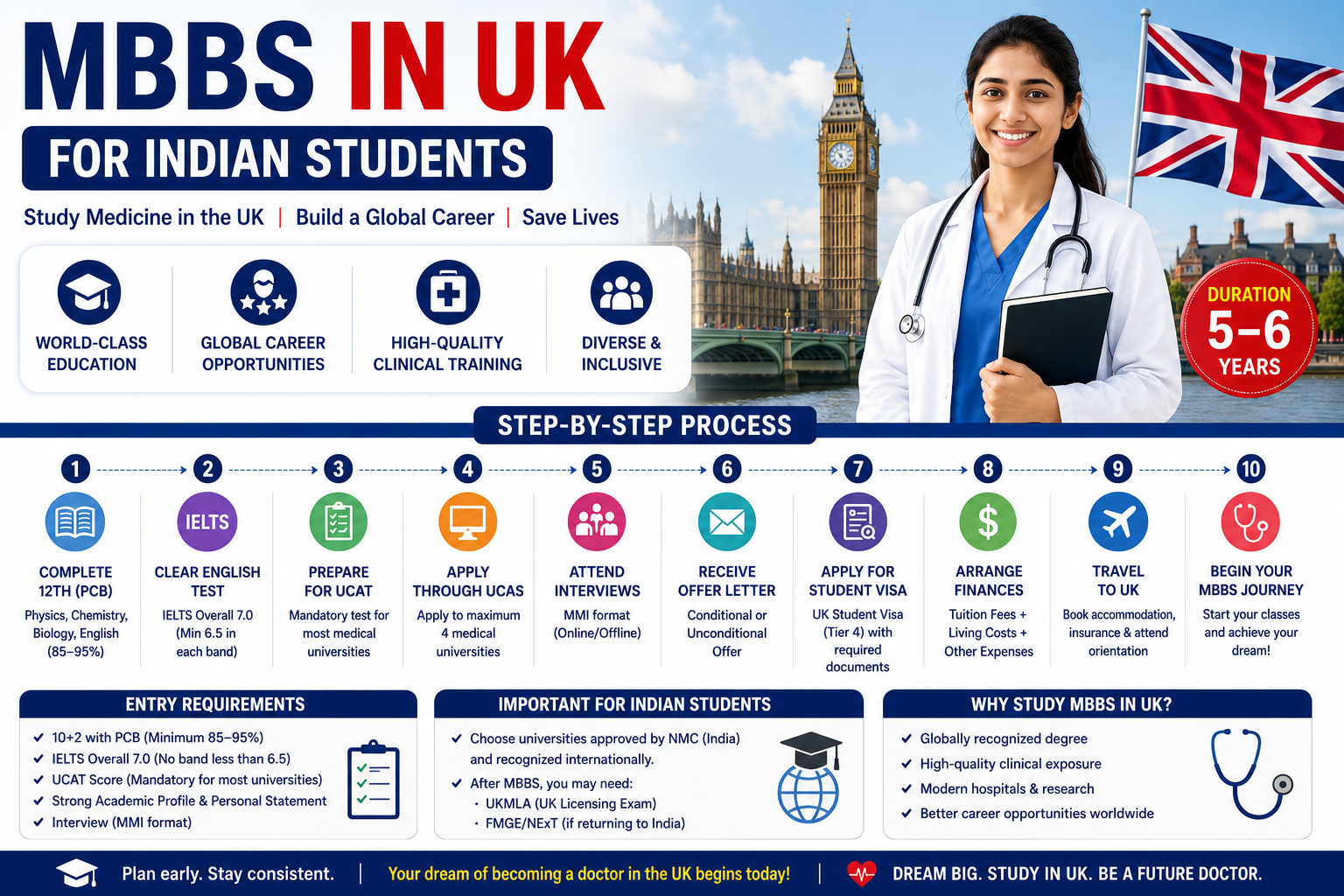
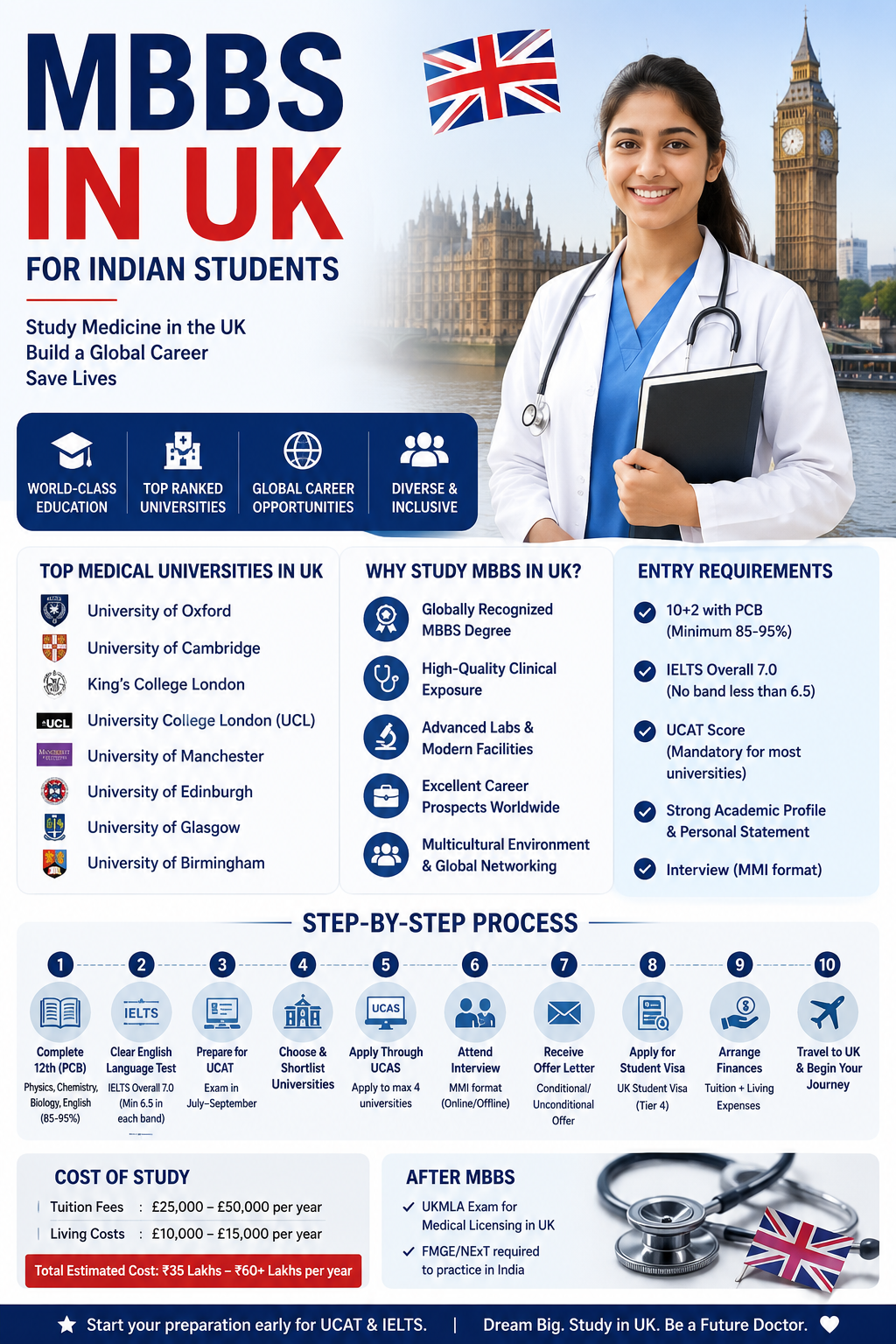
 The UK is one of the best countries for direct MBBS after 12th, unlike the USA.
In India:
12th → NEET → MBBS (5.5 years)
In UK:
12th → UCAT → Interview → MBBS / MBChB / MBBS Degree (5–6 years) → UKMLA → GMC Registration → Doctor
The UK medical degree may be called:
- MBBS
- MBChB
- MB BChir
- MB BCh
All are equivalent medical degrees.
Course Duration
Usually:
- 5 years (standard)
- 6 years (with foundation/intercalated year at some universities)
Examples:
- 5 years → Manchester, Leicester
- 6 years → Oxford, Cambridge, UCL (some routes)
Why Study MBBS in UK?
Advantages:
✅ Direct admission after 12th
✅ Globally respected degree
✅ Advanced hospital training
✅ GMC-recognized qualification
✅ Easier pathway to work in UK/NHS
✅ Research opportunities
✅ Degree accepted worldwide
STEP 1: Complete 12th (PCB)
Required subjects:
- Biology
- Chemistry
- Physics / Mathematics
- English
Minimum academic score:
Most universities require:
85–95% overall
Top universities prefer:
90–95%+ in PCB
Examples:
- Oxford/Cambridge: Very high scores
- Mid-tier Russell Group: 85–90%
STEP 2: Qualify NEET (Important for Indian Students)
UK universities usually do NOT require NEET for admission.
BUT:
If student wants to practice medicine in India later, NEET qualification is required under Indian foreign medical graduate rules.
So safest advice:
Appear for NEET and qualify
STEP 3: Take English Language Test
Choose one:
- IELTS Academic (most common)
- TOEFL iBT
- Pearson PTE (some universities)
Typical requirement:
IELTS:
- Overall 7.0–7.5
- No band less than 6.5–7.0
Documents needed:
- Passport
- Exam registration confirmation
- Score report
STEP 4: Take UCAT Exam (Most Important Exam)
The UCAT (University Clinical Aptitude Test) is required by most UK medical schools.
Important:
BMAT has been discontinued.
UCAT is now the main UK medicine admission exam.
UCAT Sections
1. Verbal Reasoning
Tests:
- Reading comprehension
- Logic
- Inference
2. Decision Making
Tests:
- Logical puzzles
- Data interpretation
- Problem-solving
3. Quantitative Reasoning
Tests:
- Basic maths
- Ratios
- Percentages
- Tables/graphs
4. Situational Judgement Test (SJT)
Tests:
- Ethics
- Professional judgement
- Doctor-patient decision making
UCAT Scoring
Range:
1200–3600
Competitive scores:
- Good: 2600+
- Strong: 2800+
- Top schools: 3000+
Test window:
Usually July–September
Valid for:
1 admission cycle only
Indian test centres:
Pearson VUE centers in major Indian cities
STEP 5: Build Medical Profile
UK medical schools value:
Clinical exposure
Examples:
- Hospital observation
- Clinic volunteering
- Shadowing doctors
Community service
Examples:
- NGO work
- Elder care volunteering
- Teaching projects
Leadership
Examples:
- School captain
- Science clubs
- Debate/public speaking
Reflection writing
Student must explain:
“What did I learn from healthcare experience?”
Very important for interviews.
STEP 6: Apply Through UCAS
All UK medical applications go through:
Deadline:
15 October (strict medicine deadline)
Students can apply to maximum 4 medical schools
Documents Required for UCAS Application
Academic Documents
- Class 10 marksheet
- Class 12 marksheet / predicted grades
- School transcripts
Identity Documents
- Passport copy
Test Scores
- UCAT score
- IELTS / TOEFL score
- NEET score (optional for UK, useful for India return)
Personal Statement
This is critical.
Must explain:
- Why medicine?
- Why UK?
- Clinical exposure
- Leadership
- Reflection
- Motivation
Letter of Recommendation
Usually from:
- Biology teacher
- Chemistry teacher
- Principal / counselor
STEP 7: Shortlisting for Interview
Universities shortlist based on:
- Academic score
- UCAT score
- Personal statement
- References
If shortlisted → Interview invite
STEP 8: Attend Medical School Interview
Usually:
MMI (Multiple Mini Interview)
This is the standard UK format.
Stations test:
- Ethics
- Communication
- Role play
- Teamwork
- Problem solving
- NHS values
- Motivation for medicine
Common questions:
- Why medicine?
- Why doctor?
- Why our university?
- Ethical dilemma examples
- Healthcare current affairs
Interview period:
Nov – March
STEP 9: Receive Offer Letter
Types:
Conditional Offer
Need final marks / IELTS requirement
Unconditional Offer
Fully admitted
STEP 10: Apply for UK Student Visa
Visa type:
UK Student Visa
Needed documents:
- CAS letter (Confirmation of Acceptance for Studies)
- Passport
- Financial proof
- Academic documents
- English test score
- TB certificate
- Visa fee receipt
Visa fee:
~£490
Immigration Health Surcharge:
~£776/year
STEP 11: Study MBBS in UK (5–6 years)
Years 1–2
Basic sciences:
- Anatomy
- Physiology
- Pharmacology
- Pathology
- Biochemistry
Years 3–5
Clinical rotations:
- Medicine
- Surgery
- Pediatrics
- Psychiatry
- Obstetrics & Gynecology
- Emergency Medicine
- General Practice
Strong NHS clinical exposure
STEP 12: Take UKMLA
After graduation:
Students take
UKMLA (UK Medical Licensing Assessment)
Required for GMC registration and UK medical practice.
STEP 13: GMC Registration
Register with:
After registration:
Can work as UK doctor
STEP 14: Foundation Training
2 years paid NHS training:
- Foundation Year 1
- Foundation Year 2
Salary:
£32,000–£45,000+
STEP 15: Specialist Training
Examples:
- GP → 3 years
- Internal Medicine → 3 years
- Surgery → 5–8 years
Then become consultant doctor.
Total Cost for Indian Students
Tuition:
£30,000–£75,000/year
Living:
£12,000–£18,000/year
Total 5–6 years:
₹2.5 crore – ₹5+ crore
Very expensive.
Top UK Medical Universities for Indian Students
Some strong choices:
- University of Oxford
- University of Cambridge
- Imperial College London
- University College London
- King’s College London
- University of Manchester
- University of Leicester
- University of Edinburgh
Best Student Profile for UK MBBS
Ideal student has:
✅ 90%+ in PCB
✅ Strong English
✅ Good UCAT score
✅ Hospital exposure
✅ Strong interview communication
✅ Financial capability
✅ Wants UK/NHS/global medical career
Timeline Example
Age 17–18 → 12th complete
Age 18 → UCAT + UCAS apply
Age 18–24 → MBBS
Age 24–26 → Foundation training
Age 26+ → Doctor in UK
Final Advice
For Indian students:
UK is much easier than USA because it allows direct medical entry after 12th.
But it is:
- Highly competitive
- Very expensive
- Requires strong UCAT + interview performance
If a student has:
90%+ academics + good English + serious medicine commitment + budget
UK is one of the world’s best MBBS destinations.