

MBBS in Italy for Indian Students (2026 Complete Guide)
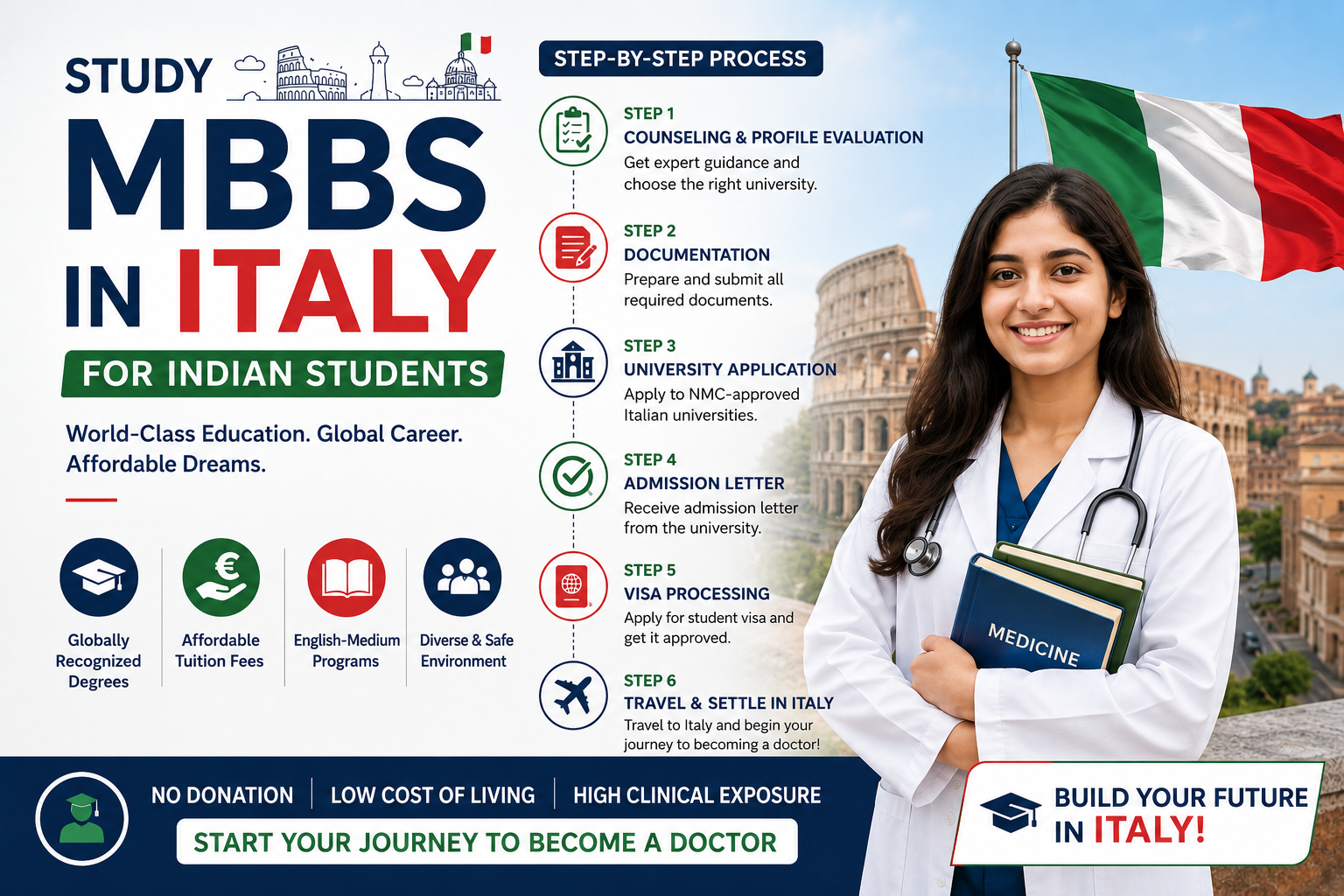
Italy is one of the best destinations for Indian students who want a globally recognized medical degree at a lower cost than many private medical colleges in India. The medical degree is called LM-41 (Medicine and Surgery), a 6-year program equivalent to MBBS/MD. It is taught entirely in English at public medical universities through the IMAT entrance exam.
1. Basic Eligibility for Indian Students
Academic Requirements
- Class 12 with Physics, Chemistry, Biology
- Minimum 50% PCB (General Category)
- Minimum 40% PCB (Reserved Categories)
- Age 17+ by 31 December of admission year
- Valid passport
NEET Requirement
For admission in Italy, universities primarily require IMAT. However, Indian students who may want to practice in India later should qualify NEET to remain eligible under Indian regulations.
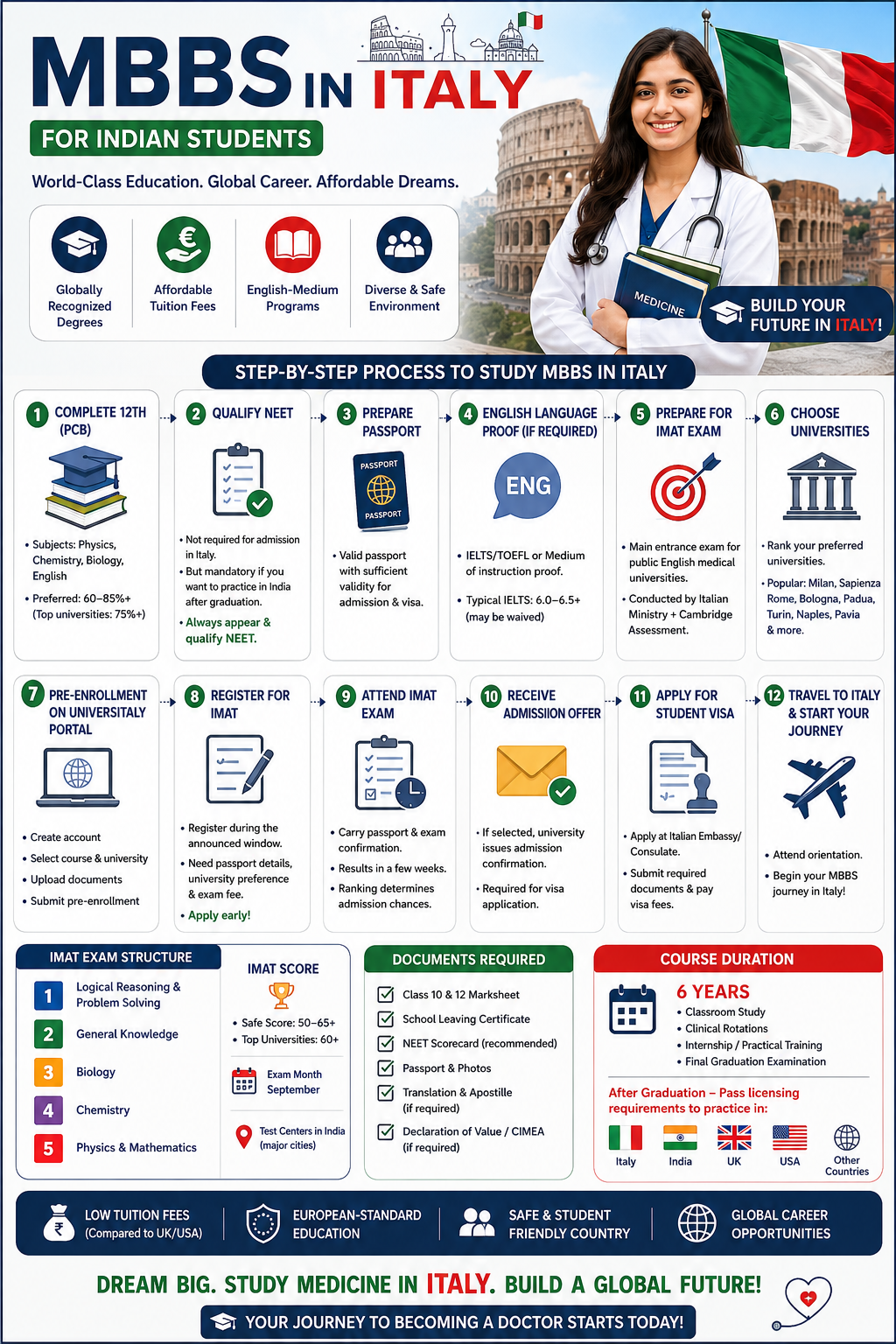
2. Step-by-Step Admission Process
Step 1: Complete Class 12
Finish 12th Science (PCB).
Step 2: Prepare for IMAT
IMAT = International Medical Admissions Test.
It is the only entrance exam for English-taught medicine at Italian public universities.
Subjects
- Logical Reasoning
- Critical Thinking
- Biology
- Chemistry
- Physics
- Mathematics
- General Knowledge
Difficulty Level
| Exam | Difficulty |
| NEET Biology | Harder than IMAT Biology |
| IMAT Logic | Harder than NEET |
| Chemistry | Similar |
| Physics | Similar |
| Overall | Moderate |
Students with a strong NEET background generally adapt well to IMAT after practicing logical reasoning.
Step 3: Register for IMAT
Timeline (Typical)
| Activity | Period |
| Registration | August |
| IMAT Exam | September |
| Results | October |
| Rankings | October |
| University Allocation | October–January |
IMAT Fee
Approximately €130+ (12000-15000)
IMAT Total Marks
- Total Score: 90 Marks
- Duration: 100 Minutes
- Negative Marking Applicable.
Safe IMAT Score for Non-EU Students
| IMAT Score | Admission Chances |
| 75+ | Almost all universities |
| 70–75 | Bologna, Pavia, Milan, Sapienza |
| 65–70 | Padua, Turin, Parma |
| 60–65 | Catania, Naples, Marche |
| 50–60 | Messina, Bari, Cagliari |
| Below 50 | Difficult for public universities |
Recent non-EU cutoffs have ranged from about 49 to 73, depending on the university and competition.
Step 4: Register on Universitaly
Create an account on the official Universitaly portal and: https://www.universitaly.com/first-steps
- Select your preferred university.
- Complete the pre-enrollment process.
- Register for the IMAT when registration opens
Step 5: Pre-Enrolment on Universitaly
Upload:
- Passport
- 10th Marksheet
- 12th Marksheet
- Passport Photos
- Other required documents
University Registration Portal : https://www.universitaly.com/first-steps
Step 6: Take the IMAT
Appear for the exam at your chosen test center. Admission depends on:
- Your IMAT score.
- The university ranking and available seats.
IMAT Portal : https://imatquest.org/about-imat/?utm_source=chatgpt.com
Step 7: Choose Universities
You choose your university preferences while applying.
Admission is based on:
- IMAT Score
- Seat Availability
- Preference Order
Step 8: Receive Admission Offer
If your score meets the cutoff:
- Accept the admission offer.
- Submit the required documents to the university.
Step 9: Receive Ranking & Seat
Possible statuses:
- Assigned
- Booked
- Waiting
Italy uses a seat movement system called Scorrimento, where seats move until all are filled.
Step 9: Student Visa Documents
Apply for Italian Type-D Student Visa.
Documents include:
- Admission Letter
- 10th and 12th mark sheets
- Passport
- NEET scorecard
- IMAT score
- Passport-size photos
- Declaration of Value (DoV) or CIMEA equivalence (if required)
- English language proof (if requested by the university)
- Financial Proof
- Accommodation Proof
- Insurance
- Visa Form
Step 9: Travel to Italy
After visa approval:
- Book your flight
- Complete university enrolment
- Start classes
- Apply for a residence permit after arriving in Italy.
Step 10: Study Medicine in Italy (6 Years)
Years 1–2
Basic sciences:
- Anatomy
- Biochemistry
- Histology
- Physiology
Years 3–4
Intermediate medical sciences:
- Pathology
- Pharmacology
- Diagnostics
- Clinical methodology
Years 5–6
Clinical rotations:
- Internal medicine
- Surgery
- Pediatrics
- Psychiatry
- Gynecology
- Emergency medicine
Hospital training is integrated.
3. Top Public (Government) Medical Universities in Italy
Public Universities (English Medicine)
- University of Bologna
- University of Padua
- Sapienza University of Rome
- University of Pavia
- University of Milan
- University of Turin
- University of Parma
- University of Messina
- University of Naples Federico II
- University of Catania
- University of Bari
- University of Cagliari
There are currently around 17 English-medium public (Government) medicine programs.
Private Medical Universities
Private universities generally have much higher fees.
Examples include:
- Humanitas University
- Università Cattolica del Sacro Cuore
- UniCamillus
Private university tuition can range from €15,000–25,000+ per year.
4. Non-EU Seats Available (Recent Intake)
Approximate non-EU seats:
| University | Non-EU Seats |
| Messina | 56 |
| Catania | 60 |
| Marche | 60 |
| Campania | 50 |
| Parma | 45 |
| Naples Federico II | 45 |
| Pavia | 40 |
| Turin | 32 |
| Padua | 25 |
| Bologna | 20 |
| Tor Vergata | 20 |
| Cagliari | 20 |
| Bicocca | 18 |
| Milan | 15 |
| Sapienza | 13 |
| Bari | 11 |
Total public non-EU seats are approximately 500–550 annually.
5. (A) Tuition Fees
Italian public (Govt) universities charge income-based tuition.
Typical Fee Range
| Category | Annual Cost |
| Low Income / Scholarship | €0–1,000 |
| Most Indian Students | €1,500–3,000 |
| Maximum Public Tuition | €4,500 |
In INR
Approximately:
- ₹1.5 lakh – ₹4.5 lakh per year
(B) Tuition Fees (Public Universities)
| Category | Annual Fee |
| Lowest | €0–1,000 |
| Most Indian Students | €1,500–3,000 |
| Highest Public Fee | €4,500 |
Typical Indian student tuition:
₹1.5 lakh – ₹3.5 lakh per year.
6. Living Expenses
| Expense | Monthly |
| Accommodation | €250–600 |
| Food | €150–300 |
| Transport | €20–50 |
| Miscellaneous | €100–250 |
Total:
€500–1200/month depending on city.
7. Total Cost for 6 Years
Without Scholarship
| Item | Approx Cost |
| Tuition | ₹10–20 lakh |
| Living | ₹45–75 lakh |
| Visa + Insurance + Flights | ₹3–5 lakh |
| Total | ₹60 lakh – ₹1.1 crore |
8. DSU Scholarship (Most Important Section)
DSU (Diritto allo Studio Universitario) is a regional government scholarship available to eligible students based primarily on financial need.
Benefits can include:
✅ Full Tuition Fee Waiver
✅ Free Hostel/Accommodation
✅ Free or Subsidized Meals
✅ Annual Cash Grant/Stipend
✅ Reduced Living Costs
9. How to Apply for DSU Scholarship
Step 1: Secure University Admission
- Clear IMAT
- Receive admission offer
- Complete enrollment
Step 2: Collect Financial Documents
Usually required:
- Father Income Certificate
- Mother Income Certificate
- Family Income Certificate
- Bank Statement
- Property Documents
- Family Composition Certificate
- Passport Copy
- Admission Letter
Requirements vary by region.
Step 3: Translation & Legalization
Documents generally require:
- English/Italian Translation
- Apostille
- Legalization where required
Step 4: Obtain ISEE Parificato
ISEE Parificato is the financial assessment used to determine scholarship eligibility.
The lower the family income and assets, the better the chance of receiving DSU benefits.
Step 5: Submit DSU Application
Depending on region:
- ER.GO (Emilia-Romagna)
- EDISU (Piedmont)
- Lazio Disco
- DSU Toscana
- ESU Veneto
Applications are generally submitted online.
Step 6: Scholarship Ranking
Authorities review:
- Family Income
- Family Assets
- Documents
- Student Status
Step 7: Final Approval
After approval, students may receive:
- Tuition Waiver
- Accommodation
- Meal Benefits
- Scholarship Payments
10. MBBS Cost with DSU Scholarship
| Expense | Without DSU | With DSU |
| Tuition | ₹10–20 lakh | ₹0–3 lakh |
| Accommodation | ₹20–35 lakh | Often Free |
| Food | ₹10–15 lakh | Subsidized/Free |
| Total Cost | ₹60 lakh–₹1.1 crore | Approximately ₹15–35 lakh |
Actual amounts vary by city, region, and scholarship category.
11. Recognition
Italian medical degrees are recognized by:
- World Health Organization
- National Medical Commission
- Educational Commission for Foreign Medical Graduates
- General Medical Council
12. Final Thesis / Graduation Exam in Italy After MBBS (Medicine & Surgery)
After completing the 6-year Medicine & Surgery degree in Italy, every student must complete a Final Thesis (Tesi di Laurea) and attend the Graduation Examination (Esame di Laurea) to receive the medical degree. The final examination consists of preparing and publicly defending a thesis before a university commission.
Step 1: Complete All Academic Requirements
Before applying for graduation, you must:
- Pass all university exams.
- Complete all required clinical rotations and internships.
- Earn all required credits (usually 360 ECTS over 6 years).
- Complete the practical evaluation internship (TPV/TPVES where applicable).
- Pay all university fees.
Step 2: Choose a Thesis Supervisor
Usually during the final year (5th–6th year), you select:
- A Professor (Supervisor/Relatore)
- Sometimes a Co-supervisor (Correlatore)
The supervisor guides you through your research project and thesis writing. Some universities require the thesis topic to be registered several months before graduation.
Step 3: Complete Thesis Research
Common thesis types:
Experimental Thesis
- Original research
- Clinical studies
- Laboratory studies
- Data analysis
Compilation/Literature Thesis
- Review of published medical literature
- Systematic review
- Case-based discussion
Experimental theses generally receive higher academic recognition but require more work.
Step 4: Write the Thesis
Typical structure:
- Title Page
- Abstract
- Introduction
- Literature Review
- Methodology
- Results
- Discussion
- Conclusion
- References
Typical length:
- 50–150+ pages
- Depends on university and department
Usually written in:
- English (English-taught programs)
- Italian (Italian-taught programs)
Step 5: Apply for Graduation
Most universities use online student portals.
Typical requirements:
- Submit graduation application.
- Upload thesis PDF.
- Upload abstract.
- Complete alumni questionnaire (AlmaLaurea in many universities).
- Pay graduation application fee if required.
Cost of Final Thesis / Graduation Exam
Unlike many countries, Italy generally does not charge a separate large thesis examination fee.
Typical costs:
| Item | Approximate Cost |
| Graduation application fee | €16–€100 |
| Revenue stamp (Marca da Bollo) | €16 |
| Thesis printing (optional) | €20–€150 |
| Hardbound copies (optional) | €30–€100 |
| Total Typical Cost | €30–€250 |
In Indian Rupees:
- €30 ≈ ₹3,000
- €250 ≈ ₹25,000
Many universities now accept fully digital submission, reducing costs significantly.
Step 6: Thesis Defense (Viva)
On graduation day:
Presentation
You present:
- Research objective
- Methods
- Findings
- Conclusions
Usually using PowerPoint slides.
Duration
Typically:
- 10–20 minutes presentation
- 5–15 minutes questions
Examination Commission
A panel of professors evaluates:
- Scientific quality
- Research methods
- Presentation skills
- Understanding of the topic
Some universities have 7–11 commission members.
Is There a Separate Medical Licensing Exam After MBBS?
Current Italian System
For modern Italian Medicine & Surgery degrees, the graduation examination itself is generally part of the qualifying process, provided the required practical training (TPV) has been successfully completed. The medical degree is issued as a qualifying degree for the profession of physician.
Grading System
Final score is awarded out of:
110 Marks
Examples:
- 90/110
- 100/110
- 105/110
- 110/110
Highest distinction:
110 e Lode
("110 with Honors")
Equivalent to graduating with top distinction.
Timeline for Indian Students
Year 6
- Complete clinical rotations
- Select supervisor
- Begin thesis research
Last 6–12 Months
- Collect data
- Write thesis
- Submit draft to supervisor
1–3 Months Before Graduation
- Submit graduation application
- Upload thesis
- Complete administrative requirements
Graduation Session
- Present thesis
- Answer questions
- Receive final degree
Degree awarded:
Laurea Magistrale a Ciclo Unico in Medicina e Chirurgia
Total Cost of final thesis Completion in Italy (Final Stage Only)
| Expense | Cost |
| Graduation Application | €16–€100 |
| Thesis Printing | €20–€150 |
| Binding | €10–€50 |
| Miscellaneous | €10–€50 |
| Total | €30–€250 |
Approximate Total in INR: ₹3,000–₹25,000
So, after completing your 6-year MBBS in Italy, the final requirement is usually a thesis research project, thesis submission, and public defense, with relatively low graduation costs compared to many other countries.
Most Italian programs require:
- Medical thesis/dissertation
- Clinical examination
- Graduation defense
After passing:
Receive Medicine degree.
13. After MBBS
You can pursue:
India
- FMGE/NExT
- Internship requirements as per NMC
USA
- USMLE
UK
- PLAB or current GMC pathway
Europe
- Residency programs
Germany
- Medical residency
Complete Timeline After Class 12
- Pass 12th PCB
- Qualify NEET (recommended for Indian practice eligibility)
- Prepare for IMAT (6–12 months)
- Register for IMAT (August)
- Write IMAT (September)
- Receive results (October)
- Seat allocation
- Universitaly pre-enrollment
- Student visa
- Travel to Italy
- Begin 6-year Medicine & Surgery (LM-41)
- Final thesis / Graduation exam after MBBS
- Graduate and pursue licensing/PG pathway
Italy is currently one of the most affordable Western European destinations for medicine, offering English-medium education, globally recognized degrees, and scholarship opportunities, but admission is highly competitive because only about 500–550 non-EU public medical seats are available each year.