


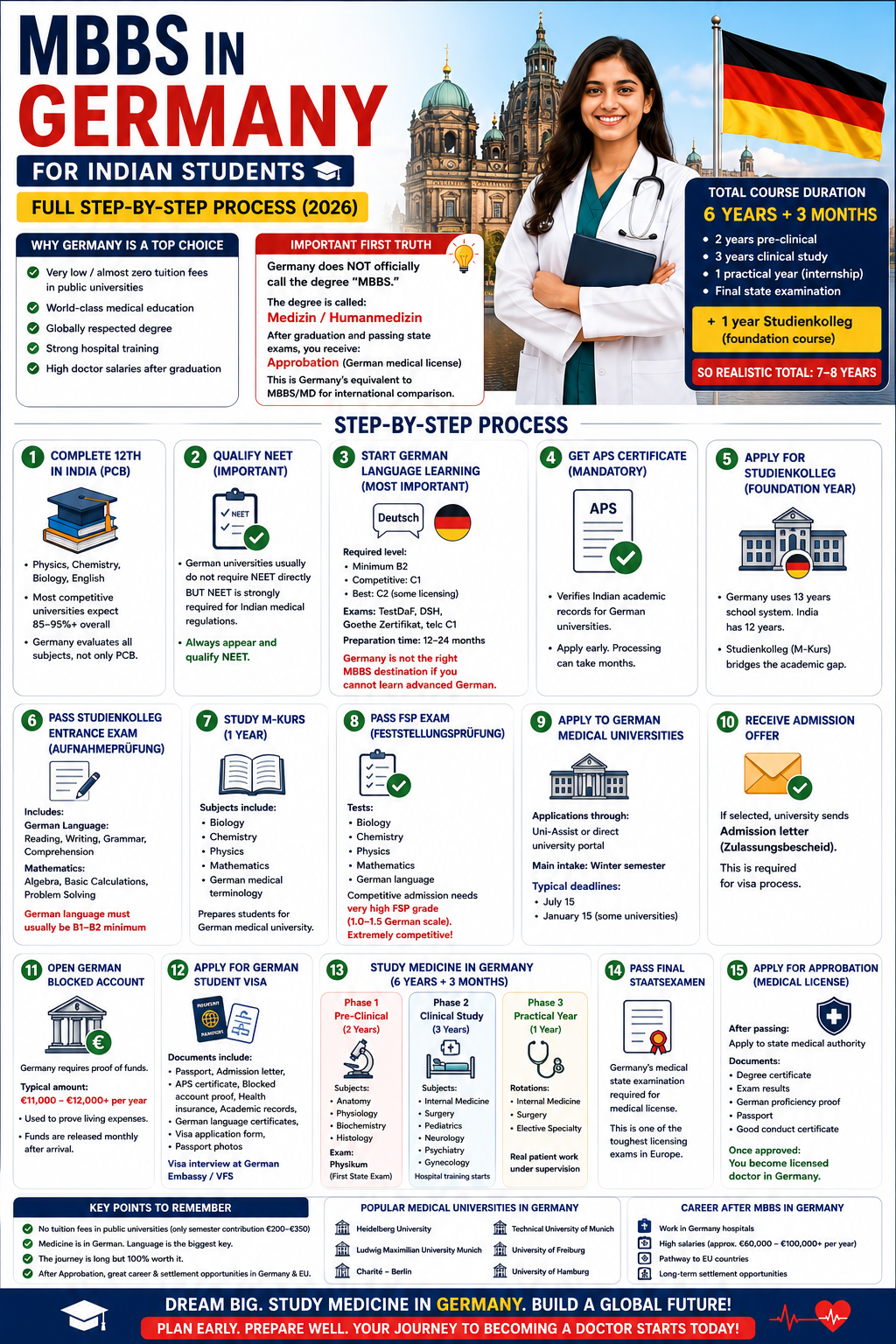
Germany is one of the best countries for medical education because:
✅ Very low / almost zero tuition fees in public universities
✅ World-class medical education
✅ Globally respected degree
✅ Strong hospital training
✅ High doctor salaries after graduation
But there is one major challenge:
Medicine in Germany is taught almost entirely in German, not English.
Students usually need B2–C1 German proficiency before admission.
Important First Truth
Germany does NOT officially call the degree “MBBS.”
The degree is called:
Medizin / Humanmedizin
After graduation and passing state exams, you receive:
Approbation (German medical license)
This is considered Germany’s equivalent to MBBS/MD for international comparison.
Total Course Duration
Usually:
6 years + 3 months
Breakdown:
- 2 years pre-clinical
- 3 years clinical study
- 1 practical year (internship)
- Final state examination
For most Indian students, add:
+ 1 year Studienkolleg (foundation course)
So realistic total:
7–8 years
FULL STEP-BY-STEP PROCESS
STEP 1: Complete 12th in India (PCB)
Required subjects:
- Physics
- Chemistry
- Biology
- English
Preferred marks:
Most competitive universities expect:
85–95%+ overall
Germany evaluates all subjects, not only PCB.
Higher marks = better admission chances.
STEP 2: Qualify NEET (Important for Indian Students)
German universities usually do not require NEET directly
BUT:
For Indian students wanting degree validity under Indian medical regulations:
NEET qualification is strongly required
Without NEET:
Returning to practice in India can become difficult.
Safe advice:
Always appear and qualify NEET
STEP 3: Start German Language Learning (Most Important Step)
This is the hardest part.
Required level:
Usually:
- Minimum B2
- Competitive: C1
- Best: C2 (some licensing stages)
Accepted exams:
- TestDaF
- DSH
- Goethe Zertifikat
- telc C1 Hochschule
Typical preparation time:
12–24 months
If student cannot commit to learning advanced German:
Germany is not the right MBBS destination
STEP 4: Get APS Certificate (Mandatory for Indian Students)
Indian students applying to Germany need:
APS Certificate (Akademische Prüfstelle)
Purpose:
Verifies Indian academic records for German universities.
Documents needed:
- Passport copy
- Class 10 marksheet
- Class 12 marksheet
- School certificates
- NEET scorecard (recommended)
- Application form
- APS fee payment proof
APS processing can take months.
Apply early.
STEP 5: Apply for Studienkolleg (Foundation Year)
Why needed?
Germany uses 13 years school system
India has 12 years
So many Indian students must complete:
Studienkolleg (M-Kurs)
This bridges the academic gap.
STEP 6: Pass Studienkolleg Entrance Exam (Aufnahmeprüfung)
Entrance test includes:
German language
Tests:
- Reading
- Writing
- Grammar
- Comprehension
Mathematics
Tests:
- Algebra
- Basic calculations
- Problem solving
German language must usually be B1–B2 minimum
STEP 7: Study M-Kurs (1 Year)
Subjects include:
- Biology
- Chemistry
- Physics
- Mathematics
- German medical terminology
This prepares students for German medical university.
STEP 8: Pass FSP Exam (Feststellungsprüfung)
This is the final Studienkolleg exam.
Tests:
- Biology
- Chemistry
- Physics
- Mathematics
- German language
Competitive medical admission often needs:
Very high FSP grade (1.0–1.5 German scale)
This is extremely competitive.
STEP 9: Apply to German Medical Universities
Applications through:
- Uni-Assist
- Direct university portal
Main intake:
Winter semester
Typical deadlines:
- July 15
- January 15 (some universities)
Documents Required for University Application
Academic Documents
- Class 10 marksheet
- Class 12 marksheet
- School transcripts
- APS certificate
- Studienkolleg certificate
- FSP results
Language Documents
- TestDaF / DSH / Goethe certificate
Medical Eligibility
- NEET scorecard
- Eligibility documents if required
Identity Documents
- Passport copy
- Passport photos
Application Documents
- Motivation letter
- CV / Resume
- Application forms
STEP 10: Receive Admission Offer
If selected:
University sends:
Admission letter (Zulassungsbescheid)
This is required for visa process.
STEP 11: Open German Blocked Account
Germany requires proof of funds.
Typical blocked amount:
Around €11,000–€12,000+ per year
Used to prove living expenses.
Funds are released monthly after arrival.
STEP 12: Apply for German Student Visa
Documents required:
- Valid passport
- Admission letter
- APS certificate
- Blocked account proof
- Health insurance
- Academic records
- German language certificates
- Visa application form
- Passport photos
Visa interview at German Embassy / VFS
STEP 13: Study Medicine in Germany (6 Years + 3 Months)
Phase 1: Pre-Clinical (2 Years)
Subjects:
- Anatomy
- Physiology
- Biochemistry
- Histology
Exam:
Physikum (First State Exam)
Phase 2: Clinical Study (3 Years)
Subjects:
- Internal medicine
- Surgery
- Pediatrics
- Neurology
- Psychiatry
- Gynecology
Hospital training starts
Phase 3: Practical Year (1 Year)
Rotations:
- Internal medicine
- Surgery
- Elective specialty
Real patient work under supervision
STEP 14: Pass Final Staatsexamen
Germany’s medical state examination
Required for medical license.
This is one of the toughest licensing exams in Europe.
STEP 15: Apply for Approbation (Medical License)
After passing:
Apply to state medical authority
Documents:
- Degree certificate
- Exam results
- German proficiency proof
- Passport
- Good conduct certificate
Once approved:
You become licensed doctor in Germany.
STEP 16: Specialist Training (Optional)
Examples:
- Internal Medicine → 5–6 years
- Surgery → 6 years
- Cardiology → 6+ years
Paid residency-style training.
Total Cost for Indian Students
Tuition (Public Universities)
Usually:
€0 tuition
Semester contribution:
€150–€350
Living Costs
€900–€1,200 per month
Yearly:
€11,000–€14,000
Total 7 years:
₹70 lakh – ₹1.2 crore approx
Much cheaper than UK/USA private medical routes.
Top German Medical Universities
Some best options:
- Heidelberg University
- Charité Berlin
- LMU Munich
- University of Freiburg
- University of Tübingen
- University of Hamburg
- RWTH Aachen
Best Student Profile for Germany MBBS
Ideal student has:
✅ 90%+ academics
✅ Strong NEET qualification
✅ Can learn German seriously
✅ Can spend 1–2 years on language prep
✅ Wants long-term Europe career
✅ Patient and disciplined
Timeline Example
Age 18 → 12th complete
Age 18–20 → German language + APS
Age 19–20 → Studienkolleg
Age 20–26 → Medical degree
Age 26+ → Approbation
Age 27+ → Doctor in Germany
Final Advice
Germany is excellent but not easy.
It is ideal only for students who are:
- academically excellent
- serious about German language
- patient for long preparation
- aiming for Europe-based medical career
If student wants:
Fast admission + English-medium MBBS
Choose:
- Georgia
- Hungary
- Poland
- Czech Republic
If student is ready for hard preparation but world-class low-cost education, Germany is one of the best choices in the world.