

Canada is one of the most respected countries for medical education, with excellent training, strong research opportunities, and high doctor salaries.
But there is one very important truth:
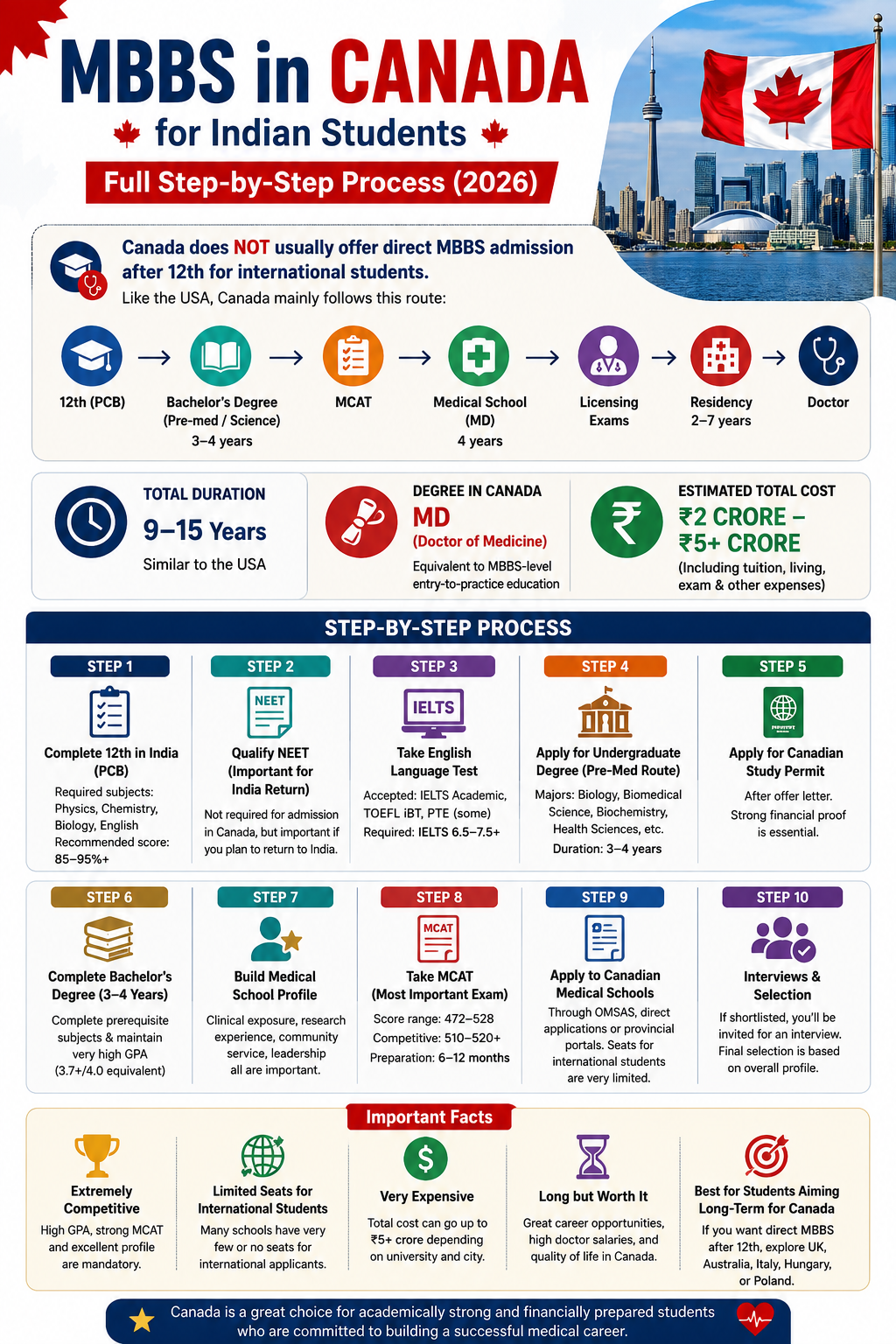
Canada does NOT usually offer direct MBBS admission after 12th for international students.
Like the USA, Canada mainly follows this route:
12th → Bachelor’s Degree (Pre-med / Science, 3–4 years) → MCAT → Medical School (MD, 4 years) → Licensing Exams → Residency → Doctor
So medicine in Canada is a long, expensive, and highly competitive pathway for Indian students.
Important First Truth
Canada does not generally use the term “MBBS.”
The degree is usually:
MD (Doctor of Medicine)
This is Canada’s professional medical qualification and is equivalent to MBBS-level entry-to-practice education for licensing purposes.
Total Duration
Typical route:
- 3–4 years undergraduate degree
- 4 years MD
- 2–7 years residency
Total:
9–15 years
This is similar to the USA.
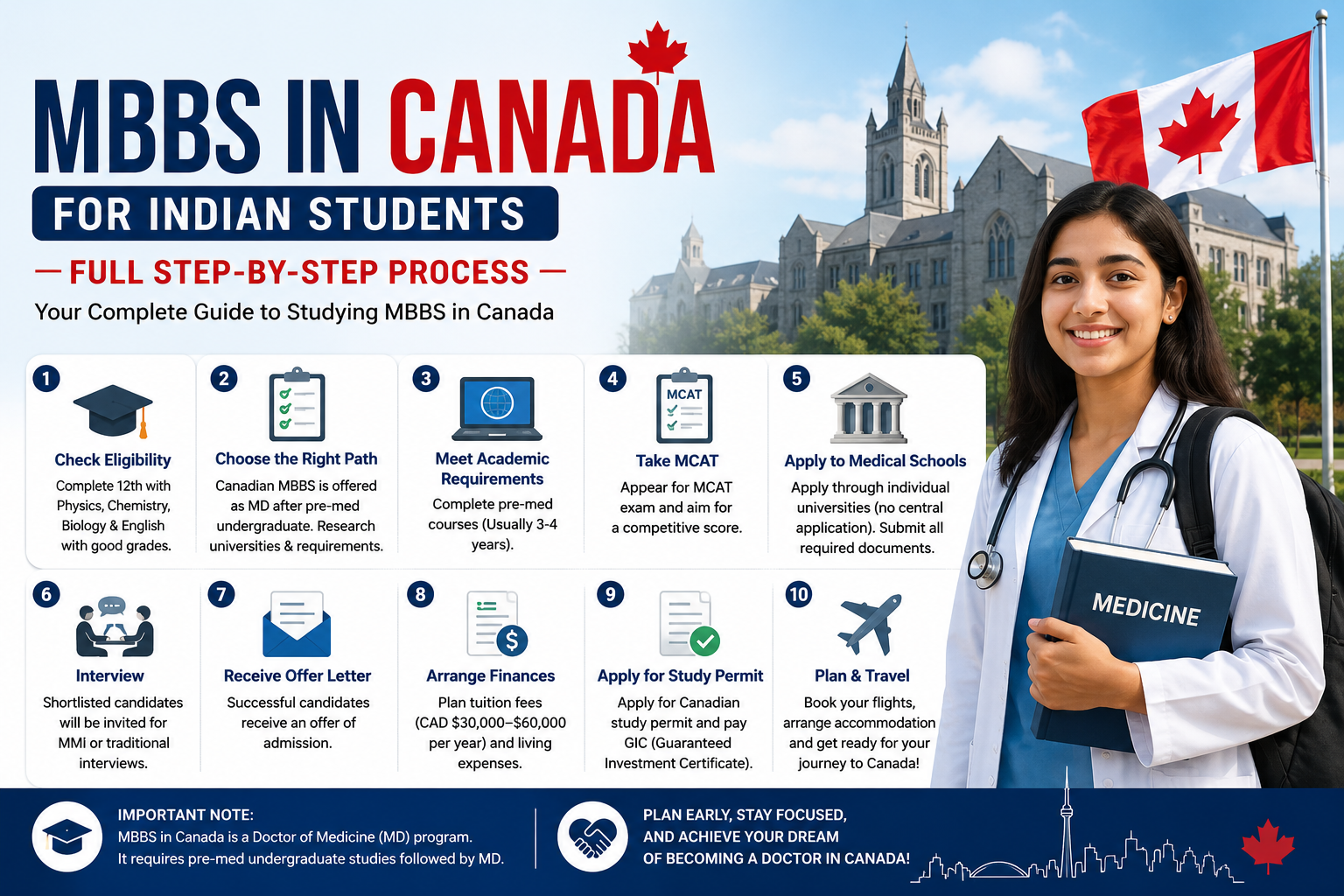
FULL STEP-BY-STEP PROCESS
STEP 1: Complete 12th in India (PCB)
Required subjects:
- Physics
- Chemistry
- Biology
- English
Recommended score:
85–95%+
Canadian medical pathways are highly competitive.
Top academic consistency is expected.
STEP 2: Qualify NEET (Important for India Return)
Canadian universities usually do not require NEET
BUT:
If student plans to return to India later for medical practice recognition purposes, NEET qualification may be important under Indian foreign medical graduate regulations.
Safe advice:
Appear and qualify NEET
STEP 3: Take English Language Test
Accepted:
- IELTS Academic
- TOEFL iBT
- Pearson PTE (some institutions)
Typical requirement:
IELTS:
6.5–7.5+
Competitive science programs often prefer strong scores.
Documents needed:
- Passport
- Test registration
- Official score report
STEP 4: Apply for Undergraduate Degree (Pre-Med Route)
Indian students cannot usually enter Canadian medical school directly after 12th.
You first complete a bachelor’s degree.
Common majors:
- Biology
- Biomedical Science
- Biochemistry
- Health Sciences
- Neuroscience
- Chemistry
Duration:
3–4 years
Popular universities:
- University of Toronto
- University of British Columbia
- McGill University
- McMaster University
- University of Alberta
- Western University
- University of Ottawa
Documents Required for Undergraduate Admission
Academic Documents
- Class 10 marksheet
- Class 12 marksheet
- School transcripts
Exam Documents
- IELTS / TOEFL scores
SAT may be required by some institutions (varies).
Identity Documents
- Passport copy
- Passport-size photographs
Written Documents
- Statement of Purpose
- Essays (if required)
Recommendation Letters
Usually from:
- Science teachers
- School principal / counselor
STEP 5: Apply for Canadian Study Permit
After receiving offer letter:
Apply for:
Canadian Study Permit
Documents needed:
- Passport
- Offer letter
- Financial proof
- Academic documents
- IELTS/TOEFL
- Statement of purpose
- Biometrics
- Medical examination (if required)
Strong financial proof is essential.
STEP 6: Complete Bachelor’s Degree (3–4 Years)
During undergraduate study, complete prerequisite subjects required by medical schools.
Typical prerequisites:
- Biology
- Chemistry
- Organic chemistry
- Biochemistry
- Psychology
- Statistics
- Physics
- Writing/communication courses
Maintain:
Very high GPA (often 3.7+/4.0 equivalent)
This is extremely important.
STEP 7: Build Medical School Profile
Canadian medical schools value:
Clinical Exposure
Examples:
- Hospital volunteering
- Patient support work
- Doctor shadowing (if available)
Research Experience
Very important in Canada
Examples:
- Lab research
- Publications
- Research assistantships
Community Service
Examples:
- NGO work
- Public health outreach
- Teaching/community leadership
Leadership
Examples:
- Clubs
- Student government
- Medical societies
STEP 8: Take MCAT (Most Important Exam)
Official exam:
Medical College Admission Test (MCAT)
Required by many Canadian medical schools.
MCAT Sections
1. Biological & Biochemical Foundations
Biology + Biochemistry
2. Chemical & Physical Foundations
Chemistry + Physics
3. Psychological & Social Foundations
Psychology + Sociology
4. Critical Analysis & Reasoning (CARS)
Reading + reasoning
MCAT Score
Range:
472–528
Competitive Canadian scores:
510–520+
Some schools emphasize CARS heavily.
Preparation:
6–12 months
Exam fee:
Approx USD $335+
STEP 9: Apply to Canadian Medical Schools
Applications usually go through provincial systems such as:
- OMSAS (Ontario)
- Direct university applications
- Province-specific portals
Application includes:
- Undergraduate transcripts
- MCAT score
- Essays
- Activity descriptions
- References
- Clinical/research records
International seats are very limited at many schools.
This is one of the biggest challenges.
STEP 10: Medical School Interview
If shortlisted:
Interview formats:
MMI (Most common)
Tests:
- Ethics
- Communication
- Problem solving
- Empathy
- Professional judgement
Panel Interview
Traditional faculty interview
Common questions:
- Why medicine?
- Why Canada?
- Ethical scenarios
- Leadership examples
- Healthcare policy awareness
STEP 11: Study MD in Canada (4 Years)
Years 1–2
Basic sciences:
- Anatomy
- Physiology
- Pharmacology
- Pathology
- Ethics
Years 3–4
Clinical rotations:
- Internal medicine
- Surgery
- Pediatrics
- Psychiatry
- Family medicine
- Emergency medicine
- Obstetrics & gynecology
Clinical exposure is excellent.
STEP 12: Licensing Examinations
Graduates complete Canadian licensing requirements (current pathway governed by national regulators and postgraduate matching systems).
Licensing processes may change over time, so verify official requirements during study.
STEP 13: Residency Match
Apply through:
CaRMS (Canadian Residency Matching Service)
Residency duration:
- Family medicine: 2 years
- Internal medicine: 4 years
- Surgery: 5 years
- Specialty pathways longer
Residency is paid.
Typical salary:
CAD $60,000–$100,000+
STEP 14: Provincial Medical Registration
After residency + exams:
Apply for provincial medical license.
Then practice independently as doctor in Canada.
Total Cost for Indian Students
Undergraduate Degree
CAD $25,000–$60,000/year
Medical School
CAD $30,000–$95,000/year (international, where available)
Living Costs
CAD $15,000–$25,000/year
Total Estimated Cost
₹2 crore – ₹5+ crore
Canada is expensive.
Major Challenge for Indian Students
The biggest difficulty:
Very limited medical school seats for international students
Some Canadian medical schools:
- Accept very few international students
- Prefer permanent residents/citizens
- Have highly competitive selection
This makes Canada harder than many students expect.
Scholarships
Available but limited:
- Merit scholarships
- Research funding
- Undergraduate awards
Medical scholarships for international students are highly competitive.
Best Student Profile for Canada Medicine
Ideal student has:
✅ 90%+ academics
✅ Excellent English
✅ Strong financial capacity
✅ Exceptional undergraduate GPA
✅ Strong MCAT score
✅ Research experience
✅ Long-term Canada medical goal
Timeline Example
Age 18 → 12th complete
Age 18–22 → Bachelor’s degree
Age 21–22 → MCAT
Age 22–26 → MD
Age 26–30+ → Residency
Age 29–32 → Licensed doctor
Why Choose Canada?
Canada is ideal for students who want:
- Premium North American medical education
- Strong research environment
- Excellent doctor salaries
- Long-term Canadian medical career
Final Advice
Canada is one of the hardest medical destinations for Indian students because:
- Very few international seats
- Long pathway
- High competition
- High cost
It is best only for students who are:
- Academically exceptional
- Financially strong
- Ready for a 10+ year commitment
If student wants direct MBBS after 12th, better alternatives are:
- UK
- Australia
- Italy
- Hungary
- Poland
If student wants elite long-term North American medical career, Canada is an excellent but very difficult path.