

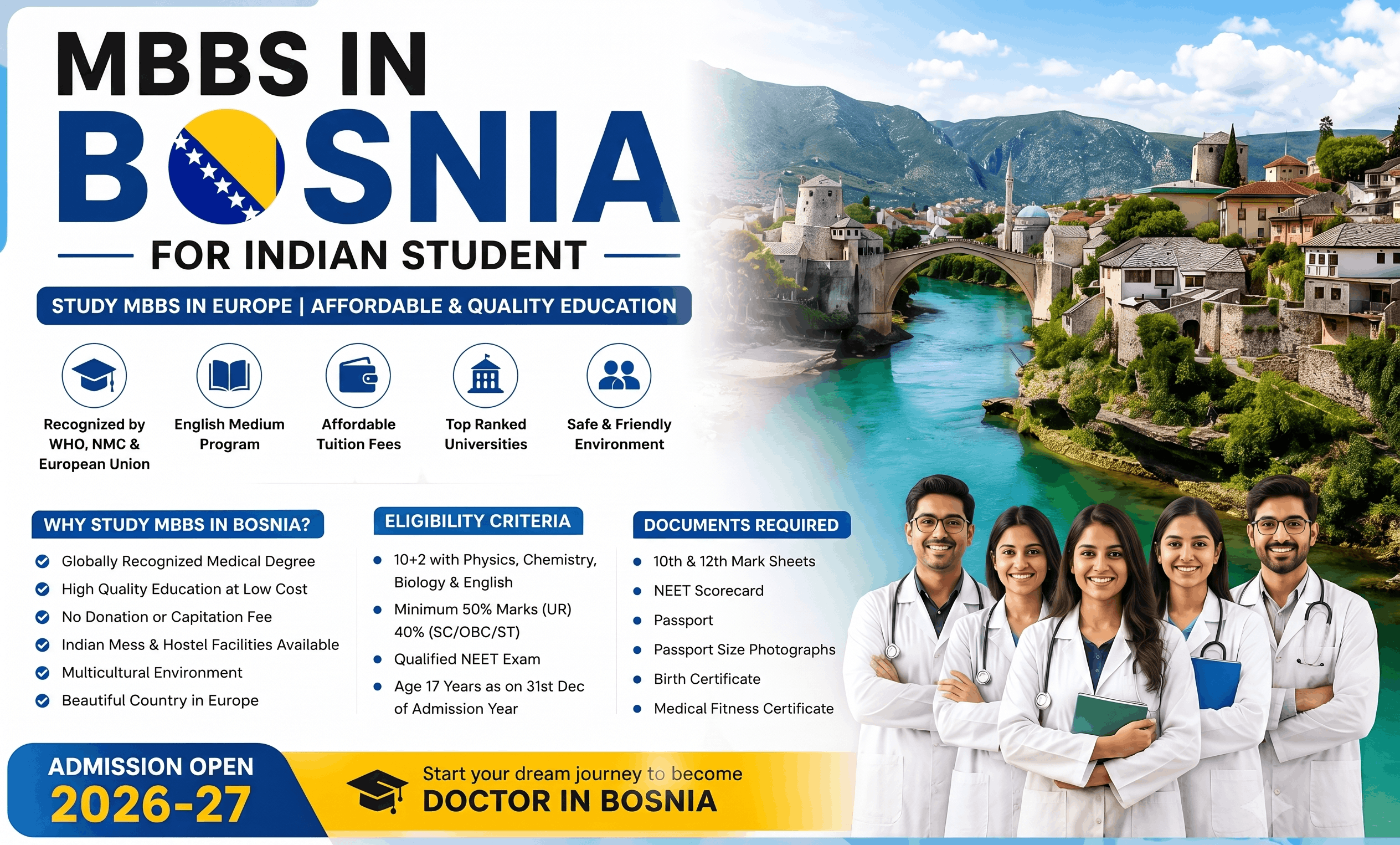
MBBS IN BOSNIA AND HERZEGOVINA
Briefing for Indian students · 2026/27 intake · Prepared August 2026
- The decision in short
Bosnia offers genuine English-medium six-year medical degrees at established public universities for roughly a tenth of Ireland's cost. Three things count against it.
- Not in the EU. No automatic recognition or practice rights anywhere in the European Union — the decisive difference from Romania, Hungary, Poland or Slovakia at comparable cost.
- The licensing route is undocumented for foreigners. Bosnia requires a post-degree traineeship plus a professional exam before a doctor is licensed. Whether an Indian national can access it — and so satisfy India's FMGL internship rule — is stated nowhere in the public record.
- Poor information environment. Almost all English material is consultancy marketing, much of it contradictory and some demonstrably false.
The critical unresolved question
FMGL 2021 requires a 12-month internship completed after the academic course, in the same country and institution, plus registration permitting practice in the country of graduation.
Consultancy material claims the six-year programme "includes" a one-year internship. That is the sixth year of the 360-ECTS degree — coursework, not a post-graduation internship. Bosnia's actual route is a traineeship (pripravnički staž) then a professional exam (stručni ispit), administered separately by each entity.
No Bosnian university or health authority publishes whether foreign graduates can enter that traineeship. Until answered in writing, treat the India pathway from Bosnia as unproven. Section 6 sets out what to ask.
| Factor | Position |
| Degree / duration | Medical Doctor (MD), integrated 6 years / 12 semesters / 360 ECTS |
| Public medical faculties | Sarajevo, Tuzla, Mostar, Banja Luka, East Sarajevo (Foča) |
| Tuition per year | ≈ €3,580 (Foča) to €9,000 (Mostar); Sarajevo €6,135 |
| Total 6-year outlay | ≈ ₹48 lakh (Foča/Banja Luka) to ₹80–98 lakh (Sarajevo/Mostar) |
| Entrance | Entrance exam (Foča) or entrance interview (Sarajevo) |
| NEET-UG | Not used in Bosnian selection; legally mandatory for Indian licensure |
| EU practice rights | No. Bosnia is not an EU member |
| Intake | September/October; Call for Applications around mid-June |
- Universities, fees and structure
Five public medical faculties. Health and education are governed at entity level — Federation of BiH (Sarajevo, Tuzla, Mostar) and Republika Srpska (Banja Luka, Foča) — so traineeship and licensing rules differ between them. An answer from one does not bind the other.
| Faculty | Tuition / year | Notes | |
| Sarajevo (FBiH) | 12,000 BAM ≈ €6,135 | — official | Founded 1946. International Medical Degree Program since 2015/16. 360 ECTS, 5,600 contact hours. Entrance interview; ranked on four years of school grades plus Biology, Chemistry, Physics, English. Students from 17 countries including India. |
| East Sarajevo — Foča (RS) | 7,000 BAM ≈ €3,580 | — official | Public, founded 1992. Cheapest in the country. Entrance exam; 400 BAM entrance fee, 140 BAM enrolment material. Own university clinical centre. Small town. |
| Banja Luka (RS) | Low — verify | Founded 1978. English-taught Medicine and Dentistry. Largest hospital in RS as teaching base; among Europe's cheapest living costs. | |
| Tuzla (FBiH) | ≈ €3,500–6,000 — unverified | Founded 1976. Genuine university town, 15,000–19,000 students. Simpler and cheaper than Sarajevo. | |
| Mostar (FBiH) | ≈ €9,000 — unverified | Reported to admit without an entrance exam. Most expensive — at this price EU alternatives deserve direct comparison. |
Figures marked official come from the university's own website. The rest are consultancy sources that vary widely — confirm in writing before relying on them.
Structure (Sarajevo, representative): integrated first + second cycle, full-time; pre-clinical sciences years 1–3, clinical disciplines and hospital work years 4–6. Degree awarded: Medical Doctor. The faculty states the programme conforms to EU Directives 2005/36/EC and 2013/55/EC — a statement about curriculum design, not about automatic recognition (Section 7).
- Eligibility
- Completion of four-year secondary education. Sarajevo states foreign nationals compete under the same conditions as BiH citizens. Nostrification of the Indian diploma is a required step — start early.
- Physics, Chemistry, Biology at Class 12. Consultancy sources cite a 50% PCB floor; not confirmed on university sites.
- English: Sarajevo requires IELTS/TOEFL where English is not the first language, but exempts applicants holding an English-medium secondary or college diploma. Indian CBSE/CISCE students may fall within the exemption — confirm in writing rather than assuming, and ignore blanket agent claims that no test is needed anywhere.
- Age: consultancy sources cite 17–25; Sarajevo publishes no upper limit. Confirm with the faculty.
- NEET-UG: not used in Bosnian selection, legally mandatory for Indian practice. Qualify it regardless of what an agent says.
- Police clearance and health: a certificate of no criminal proceedings or convictions from Indian authorities, issued within six months, plus a medical certificate issued within three months.
- Costs
The Bosnian mark is pegged to the euro (≈ 1.96 BAM to €1), so euro-side currency risk is minimal. Rupee exposure remains.
| Component (6 years) | Foča / Banja Luka | Sarajevo / Mostar |
| Tuition | ≈ €21,500 | ≈ €37,000 – 54,000 |
| Living (€300–500/month) | ≈ €21,600 | ≈ €36,000 |
| Admission, permits, insurance | ≈ €2,500 | ≈ €4,000 |
| Travel, apostille, translation, exams | ≈ €2,500 | ≈ €4,000 |
| TOTAL | ≈ €48,000 / ₹48 lakh | ≈ €79,000–98,000 / ₹79–98 lakh |
The ₹18–35 lakh headline is wrong
Consultancy sites quote ₹18–35 lakh for six years while simultaneously quoting €300–500/month living costs. Six years at €300/month is already ~₹21 lakh in living costs alone, before any tuition.
Bosnia is genuinely cheap at the Foča end. It is not ₹18 lakh cheap, and at Sarajevo or Mostar it is no longer obviously cheaper than an EU-member alternative.
No scholarships are published for non-EU international medical students at the public faculties, and there is no advertised student work-rights regime. Assume full self-funding.
- Visa and residence permit
Long-stay Visa D from the Embassy of Bosnia and Herzegovina in New Delhi before travel, then a temporary residence permit after arrival, renewed annually. The permit documents (from a faculty's own published list) are:
Application form in block letters · 150 BAM administrative fee · photo 35×45 mm · verified passport copy valid 3 months beyond the requested period, showing data page, entry stamp and Visa D sticker · certificate of residence registration · proof of enrolment for the current year · proof of subsistence funds at 400 BAM per month · medical certificate (within 3 months) · proof of accommodation · health insurance valid in BiH · police clearance certificate from India (within 6 months).
Two things that trip students up
Everything except the police clearance can be assembled after arrival. The Indian PCC must be obtained before departure — it cannot be arranged remotely, and the six-month validity window makes timing matter.
All foreign-language documents must be translated into an official BiH language by a notarised court interpreter. Budget time and money for certified translation of every Indian document.
Also note: no direct flights from India to Sarajevo (routings via UAE, Kuwait or Turkey), and Bosnia is outside the Schengen Area — a Bosnian permit does not itself confer Schengen travel rights.
- After graduation — the gap
Documented: the six-year programme ends with graduation and the title Medical Doctor; year six is part of the degree. As across the former Yugoslavia, a graduate is not licensed on graduation — the route runs through a post-degree traineeship (*pripravnički staž*), then a professional exam (*stručni ispit*), after which the entity medical chamber issues the licence. Residency durations already differ between FBiH and RS for the same specialty, showing how far entity rules diverge.
Not documented: nothing on any university site, entity health ministry or medical chamber states whether a foreign national graduating in Bosnia may enter that traineeship, sit the exam, obtain a licence, or hold the residence status needed to do so — the student permit is tied to enrolment and ends at graduation. The answer is absent, not unfavourable. For a six-year, ₹50 lakh–₹1 crore decision that amounts to the same thing until resolved.
Ask these five questions in writing before paying anything
- Does the six-year programme constitute the complete academic course, with year six inside the 360 ECTS?
- Is a separate post-graduation traineeship required before licensing in this entity, and how many months?
- Are foreign graduates of this faculty eligible for it — and has any actually completed one? How many, in which years?
- What residence status does a foreign graduate hold during the traineeship, and who sponsors it?
- Can a foreign graduate sit the stručni ispit and be registered by the entity medical chamber?
Address these to the faculty student affairs office and the entity medical chamber — not an agent — and get them on letterhead or from an institutional email. If a faculty cannot answer question 3 with a number, that is itself the finding.
- India and other pathways
| FMGL requirement | Detail | Bosnia position | |
| Course duration | ≥ 54 months of instruction; NMC counts months, not years | Satisfied — six years, 360 ECTS | |
| Medium | Entire course in English | Satisfied at named English programmes; not at local-language faculties | |
| Internship | 12 months after the course, same country and institution | UNRESOLVED — see Section 6 | |
| Local registration | Licensure permitting practice in the country of graduation | UNRESOLVED — requires traineeship plus exam | |
| NEET-UG | Mandatory; without it no Eligibility Certificate and FMGE/NExT never possible | Qualify before admission | |
| Then in India | NMC Eligibility Certificate → | FMGE/NExT → further 12-month CRMI | Standard, in addition to the above |
"NMC approved" is a false claim. The NMC no longer publishes a list of approved foreign universities — FMGL 2021 abolished it and made verification the student's sole responsibility. Any site claiming NMC approval for a specific university is out of date or misrepresenting, and that tells you what the rest of the site is worth.
FMGE outcomes: reported pass rates cluster around 28–38%, with 35–38% cited for Sarajevo. Tiny sample, self-reported by parties selling admissions. Against a national rate of roughly 20–25% and the strongest foreign universities approaching 50%, Bosnia looks unremarkable rather than exceptional.
EU: Sarajevo's compliance statement concerns curriculum design. The directives' automatic-recognition mechanism applies to qualifications from EU/EEA member states; Bosnia is a candidate country. Recognition therefore requires individual assessment in each EU country, with language certification and often an aptitude test or adaptation period. US: open in principle via ECFMG and USMLE, but verify the specific faculty's current World Directory listing and accreditation note — that is now a hard gate. UK: GMC registration via PLAB, no institutional advantage from Bosnia.
- Risks and verdict
| Risk | Severity | Mitigation | |
| Traineeship unavailable to foreigners → Indian licensure blocked | Critical | Resolve the five Section 6 questions in writing before any deposit. Treat an unanswered question 3 as a negative answer. | |
| Enrolling on a | Bosnian/Serbian/Croatiantaught programme | Critical | FMGL requires the whole course in English. Confirm the programme name and language on the university site, not the agent's. |
| Agent mis-selling and inflated fees | High | Sarajevo and Foča publish fees openly — benchmark every quote against them. A rival consultancy openly states agents push local-language universities for higher commissions. | |
| Private institutions of unclear standing | High | Stick to the five public faculties unless a private one can evidence WDOMS listing and licensed foreign graduates. | |
| Understated cost projections | Medium | Model €400–500/month living for six years. | |
| Language barrier in clinical years | Medium | Patients speak Bosnian/Serbian/Croatian. Learn it from year one — it affects competence and FMGE readiness. | |
| Small Indian cohort, thin support | Medium | Ask how many Indian students are enrolled and how many have graduated. Ask to speak to one. |
Reasonable when: the budget genuinely rules out EU-member destinations; the target is one of the cheaper faculties (Foča, Banja Luka); the Section 6 questions are answered favourably in writing; the destination is India via FMGE/NExT; and the student will learn the local language.
Poor when: the ambition is EU practice; the target is Sarajevo or Mostar at €6,000–9,000 a year, where Poland and Romania are close enough that paying more for EU rights is the better trade; the faculty cannot answer the Section 6 questions; or the decision is being driven by an agent rather than the university's own published information.
Summary judgement
Bosnia's public faculties are real institutions with long histories, teaching hospitals and genuine English programmes. The problem is not quality — it is that the end of the pathway is undocumented. Every established MBBS-abroad destination can say how its foreign graduates get licensed. Bosnia cannot, not because the answer is bad but because nobody has published it.
With those answers in hand, the cheaper faculties are a defensible budget option. Without them, Georgia offers a similar cost profile with a far better-documented route, and should be the default comparison.
- Verify against these
Source reliability in this document: official university sites (Sarajevo and Foča) for programme structure, ECTS, tuition, selection method, fees, residence-permit requirements and subsistence thresholds. Consultancy sources — flagged in the text — for Tuzla, Mostar and Banja Luka tuition, FMGE rates, age limits and living costs. Rejected outright: "NMC approved" claims, automatic EU recognition, and ₹18–35 lakh total-cost figures.
| Body | What to verify |
| mf.unsa.ba (Sarajevo) | IMDP structure, tuition, Call for Applications, entrance interview, English requirement |
| mef.ues.rs.ba (Foča) | Tuition, entrance exam, nostrification, residence permit documents |
| Tuzla, Mostar, Banja Luka faculties | Whether an English-medium programme currently runs, and its published fee |
| Entity medical chambers (FBiH, RS) | The Section 6 questions — traineeship access, exam eligibility, licensing of foreign graduates |
| Entity health ministries | Traineeship regulations and duration |
| Service for Foreigners' Affairs, BiH | Current residence permit rules, fees, subsistence thresholds |
| Embassy of BiH, New Delhi | Visa D requirements and processing |
| wdoms.org | Current listing and ECFMG accreditation note for the specific faculty |
| nmc.org.in | FMGL Regulations 2021 gazette, Eligibility Certificate, FMGE/NExT, CRMI |
Rules differ by entity, most English-language material on this topic is marketing, and the central question in Section 6 remains unresolved. This document is informational, not legal, financial or immigration advice.