


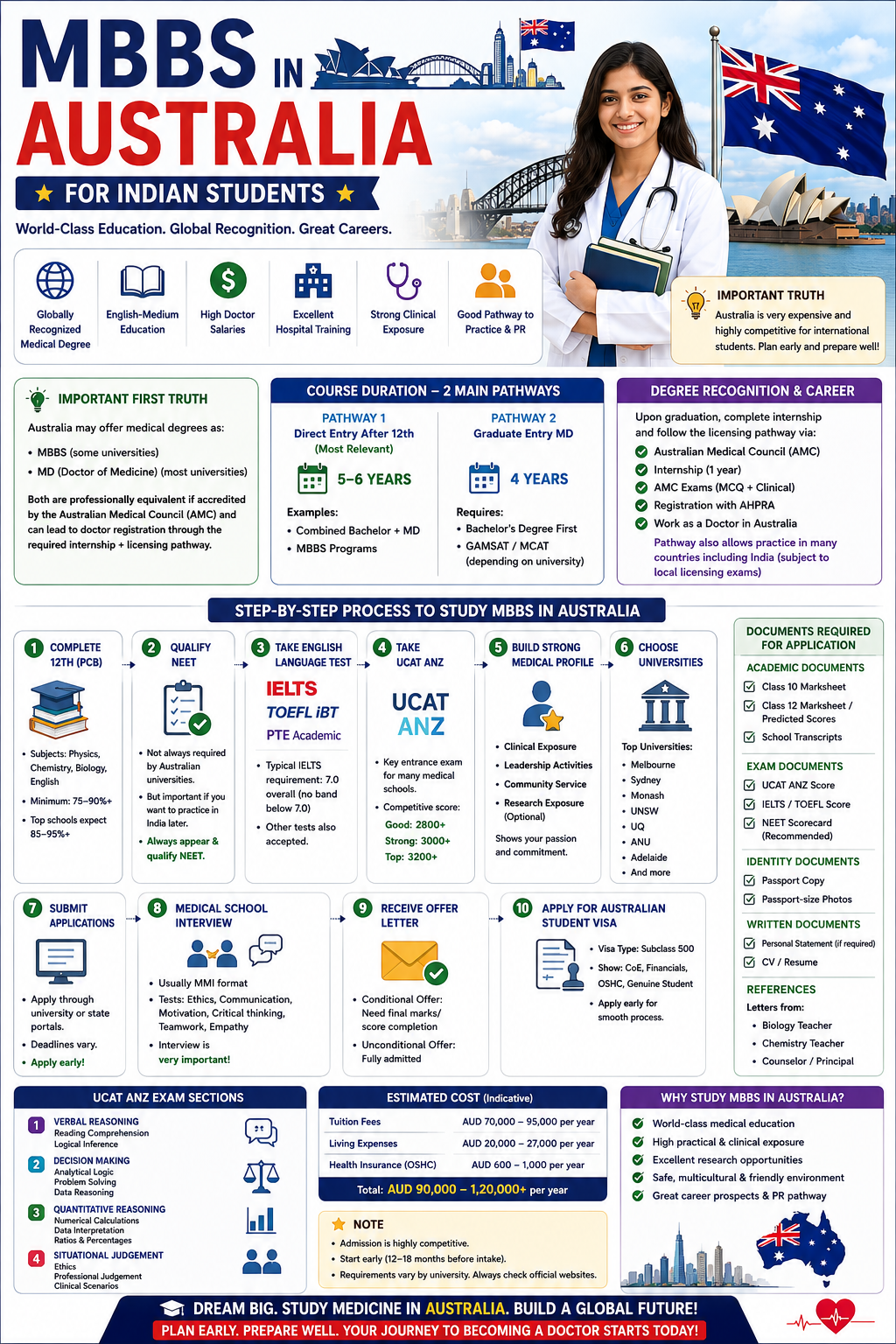
Australia is one of the best English-speaking countries for medical education because:
✅ Globally recognized medical degree
✅ English-medium education
✅ High doctor salaries
✅ Excellent hospital training
✅ Strong clinical exposure
✅ Good pathway to medical practice and long-term settlement
But there is one important truth:
Australia is very expensive and highly competitive for international students.
Important First Truth
Australia may offer medical degrees as:
- MBBS (some universities)
- MD (Doctor of Medicine) (most universities now)
Both are professionally equivalent if accredited by the Australian Medical Council (AMC) and can lead to doctor registration through the required internship + licensing pathway.
Course Duration
Australia offers two major pathways
Pathway 1: Direct Entry After 12th (Most Relevant for Indian Students)
Duration:
5–6 years
Examples:
- Combined Bachelor + MD
- MBBS programs
Pathway 2: Graduate Entry MD
Duration:
4 years
Requires:
- Bachelor’s degree first
- GAMSAT / MCAT (depending on university)
For Indian students after 12th, Pathway 1 is usually preferred.
FULL STEP-BY-STEP PROCESS
STEP 1: Complete 12th in India (PCB)
Required subjects:
- Physics
- Chemistry
- Biology
- English
Typical minimum:
75–90%+
Competitive universities often expect:
85–95%+
Top schools may expect very high academic consistency.
STEP 2: Qualify NEET (Important for Indian Students)
Australian universities may not always require NEET directly.
BUT:
If student wants to practice medicine in India later, NEET qualification is generally important under Indian foreign medical graduate rules.
Safe advice:
Always appear and qualify NEET
STEP 3: Take English Language Test
Accepted exams:
- IELTS Academic
- TOEFL iBT
- Pearson PTE Academic
Typical IELTS requirement:
7.0 overall
(No band usually below 7.0 for medicine at many universities)
Some top universities may ask higher.
Documents needed:
- Valid passport
- Test registration
- Official score report
STEP 4: Take UCAT ANZ (Most Important Exam for Direct Entry)
The UCAT ANZ is the key entrance exam for many undergraduate Australian medical schools.
Official exam:
University Clinical Aptitude Test – Australia/New Zealand
This is one of the most important admission requirements.
UCAT ANZ Exam Sections
1. Verbal Reasoning
Tests:
- Reading comprehension
- Logical inference
2. Decision Making
Tests:
- Analytical logic
- Problem solving
- Data reasoning
3. Quantitative Reasoning
Tests:
- Numerical calculations
- Data interpretation
- Ratios and percentages
4. Situational Judgement
Tests:
- Ethics
- Professional judgement
- Clinical decision scenarios
UCAT Score
Competitive scores:
- Good: 2800+
- Strong: 3000+
- Top schools: 3200+
Higher score = stronger interview chances
STEP 5: Build Strong Medical Profile
Australian medical schools value:
Clinical Exposure
Examples:
- Hospital volunteering
- Doctor shadowing
- Clinic observation
Leadership Activities
Examples:
- Student council
- Medical clubs
- Debate/public speaking
Community Service
Examples:
- NGO work
- Teaching
- Social service
Research Exposure (Optional but strong)
Useful for top universities.
STEP 6: Choose Universities
Top Australian medical schools:
- University of Melbourne
- University of Sydney
- Monash University
- University of Queensland
- University of New South Wales
- Australian National University
- University of Adelaide
- University of Western Australia
- James Cook University
These are among the most recognized medical schools.
STEP 7: Submit University Applications
Application portals vary:
Some use:
- Direct university application
- State admission portals
- Medicine-specific portals
Deadlines differ by university.
Apply early.
Documents Required for Application
Academic Documents
- Class 10 marksheet
- Class 12 marksheet / predicted scores
- School transcripts
Exam Documents
- UCAT ANZ score
- IELTS / TOEFL score
- NEET scorecard (recommended)
Identity Documents
- Passport copy
- Passport-size photos
Written Documents
- Personal statement (if required)
- CV / resume
References
Recommendation letters from:
- Biology teacher
- Chemistry teacher
- School counselor / principal
STEP 8: Medical School Interview
Shortlisted students attend interview.
Usually:
MMI (Multiple Mini Interview)
Tests:
- Ethics
- Communication
- Motivation for medicine
- Critical thinking
- Teamwork
- Empathy
Common questions:
- Why medicine?
- Why Australia?
- Why this university?
- Ethical scenarios
- Patient communication role-play
Interview performance is extremely important.
STEP 9: Receive Offer Letter
Offer types:
Conditional Offer
Need final marks / score completion
Unconditional Offer
Fully admitted
STEP 10: Apply for Australian Student Visa
Visa type:
Subclass 500 Student Visa
Documents needed:
- Passport
- Offer letter
- Confirmation of Enrollment (CoE)
- Financial proof
- IELTS/TOEFL score
- Academic records
- Genuine student statement
- Health insurance (OSHC)
- Visa fee receipt
Australian visa scrutiny for medicine students is strict.
Strong financial documentation matters.
STEP 11: Study MBBS / MD in Australia
Years 1–2
Basic medical sciences:
- Anatomy
- Physiology
- Biochemistry
- Ethics
- Clinical foundations
Years 3–4
Clinical systems:
- Pathology
- Pharmacology
- Diagnostics
- Clinical reasoning
Years 5–6
Hospital rotations:
- Internal medicine
- Surgery
- Pediatrics
- Psychiatry
- Emergency medicine
- Obstetrics & gynecology
Australian programs often provide early clinical exposure.
STEP 12: Internship (Mandatory)
After graduation:
Complete
12-month supervised internship
This is essential for registration.
Clinical practice under supervision in hospitals.
STEP 13: Register with AHPRA
Register with:
Australian Health Practitioner Regulation Agency
After internship + degree requirements:
Receive doctor registration
Can practice as medical doctor in Australia.
STEP 14: Specialist Training (Optional)
Examples:
- General Practice → 3–4 years
- Internal Medicine → 5–6 years
- Surgery → 5–7+ years
Paid training pathway.
For International Graduates Returning to India
If planning to practice in India:
Must comply with Indian foreign medical graduate licensing requirements.
NEET qualification + NMC compliance are essential.
Always verify latest rules before joining.
Total Cost for Indian Students
Tuition:
AUD 65,000–110,000 per year
Living costs:
AUD 21,000–30,000+ per year
Total full program cost:
₹1.5 crore – ₹3+ crore depending on university and city.
This makes Australia one of the world’s most expensive MBBS destinations.
Scholarships Available
Limited but available:
- Merit scholarships
- International student grants
- University-specific awards
Medical scholarships are competitive.
Do not rely fully on scholarship.
Best Student Profile for Australia MBBS
Ideal student has:
✅ 90%+ academics
✅ Strong English
✅ Excellent UCAT score
✅ Financial capacity
✅ Strong communication skills
✅ Wants English-speaking global medical career
Timeline Example
Age 17–18 → 12th complete
Age 18 → UCAT + admission
Age 18–24 → MBBS/MD study
Age 24–25 → Internship
Age 25+ → Registered doctor
Why Choose Australia?
Australia is ideal for students who want:
- Premium English medical education
- Global recognition
- Excellent clinical exposure
- Strong future salaries
- Possible long-term Australia career pathway
Final Advice
Australia is excellent but expensive.
It is best for students who have:
- Very strong academics
- Good UCAT performance
- High financial capacity
- Serious long-term commitment
If budget is lower, consider:
- Italy
- Germany
- Poland
- Hungary
If student wants top English-speaking medical education with strong career outcomes, Australia is one of the world’s best options.